
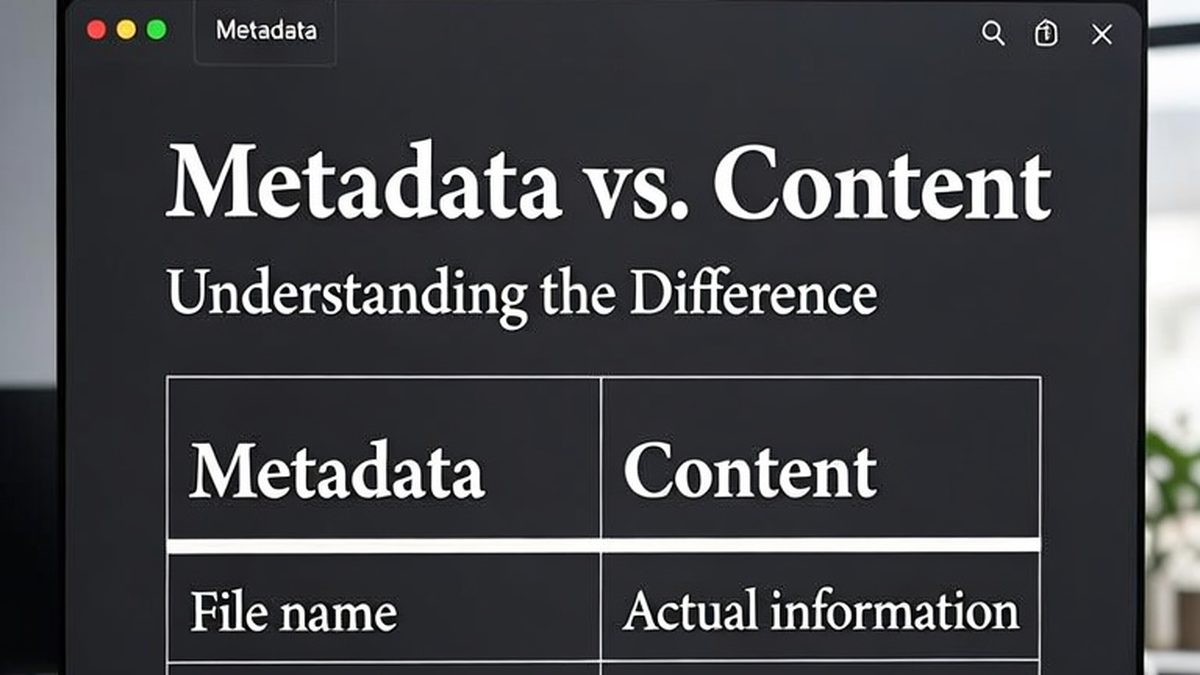
When Edward Snowden leaked NSA documents to journalists at The Guardian and The Washington Post in 2013, the public conversation centred heavily on whether the government was "listening to your calls." Officials repeatedly insisted they were collecting only metadata, not content — and that distinction was presented as reassurance.
It was not reassurance. It was misdirection. Understanding why requires a clear-eyed look at what metadata actually is, and what it reveals.
Content vs. Metadata: The Formal Distinction
Content refers to the substance of a communication: the words spoken in a call, the text of an email, the body of a message. Metadata refers to everything else: who communicated with whom, when, for how long, from where, using what device, via what network path.
Under U.S. law, content receives stronger Fourth Amendment protection. Historically, obtaining content required a wiretap order. Metadata — being treated analogously to envelope information rather than letter contents — historically required a lower legal threshold. Section 215 of the PATRIOT Act enabled bulk metadata collection from telecommunications providers with minimal judicial scrutiny. Section 702 of the FISA Amendments Act of 2008 expanded this further, permitting collection of communications data from major internet companies under the PRISM programme.
What the NSA Actually Collected
The Verizon court order leaked by Snowden revealed that the NSA was collecting the following metadata on every call made through Verizon's network, daily:
- Originating phone number
- Terminating phone number
- Duration of call
- Date and time
- Location data
- Unique device identifiers
For internet communications under PRISM, the data collected from Google, Microsoft, Facebook, Apple, and others included: email addresses of sender and recipients, IP addresses, login credentials, saved files, and both audio and video files — as well as metadata. In this context, the content/metadata distinction collapses significantly.
Why Metadata Is Often More Revealing Than Content
Former NSA general counsel Stewart Baker stated directly: "Metadata absolutely tells you everything about somebody's life." This is not hyperbole. Consider what call metadata alone can reconstruct:
- Medical conditions. Calls to oncology units, psychiatrists, HIV treatment centres, or addiction services — even without knowing what was said — establish medical context with high confidence.
- Relationship status. Frequency, duration, and timing of calls between two numbers reveals the nature and intensity of a relationship far more precisely than any single conversation.
- Political and religious activity. Calls to advocacy organisations, churches, mosques, or political campaign offices leave unambiguous records.
- Location history. Cell tower data tied to metadata produces a granular record of physical movements over months or years — effectively a travel diary.
- Financial activity. Calls to debt collection agencies, financial advisors, or bankruptcy attorneys reveal financial circumstances without a single word of content.
Researchers at Stanford University demonstrated this by analysing a small sample of phone metadata and successfully inferring medical conditions, firearm purchases, and drug use — from call patterns alone, without accessing any message content.
The Legal Landscape After Carpenter
In Carpenter v. United States (2018), the Supreme Court held that accessing seven days or more of historical cell-site location data — metadata about where a phone was when calls were made — constitutes a Fourth Amendment search requiring a warrant. This was a significant departure from the third-party doctrine, which had previously held that data shared with a third party (like a carrier) carries no constitutional protection.
Carpenter does not resolve all metadata collection questions. Bulk collection under Section 702 remains operational. The Court explicitly declined to rule on real-time tracking, GPS monitoring, or collection by intelligence agencies under foreign intelligence authorities.
Practical Implications
For individuals concerned about their privacy, the metadata-vs-content framing suggests specific countermeasures. Encrypting message content — via Signal or similar — addresses only one dimension of surveillance exposure. Reducing metadata leakage requires different approaches: limiting device identifiers shared with networks, using VoIP services that do not tie to registered phone numbers, and understanding that the pattern of your communications is itself informative regardless of what those communications say.
The Surveillance Countermeasures guide covers these approaches in operational detail, drawing from publicly available security research and declassified documents.