Reviews & Key Insights

An editorial assessment of every book in the series — what each one covers, what makes it different, and who it is written for. Honest about scope and limitations, not just strengths.

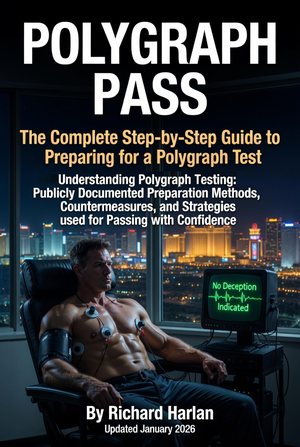
Polygraph Pass by Richard Harlan — book coverBuy on Amazon →Click cover to buy on Amazon

Polygraph Pass

The Complete Step-by-Step Guide to Preparing for a Polygraph Test

Polygraph Pass does something most books on the subject refuse to do: it takes the instrument seriously enough to examine it honestly. Rather than either defending the polygraph as a truth machine or dismissing it as pseudoscience, Harlan builds the case from the primary record — the National Research Council's 2003 review, declassified federal training material, and the peer-reviewed psychological literature — and lets the evidence land where it lands. The result is a guide that prepares the reader for the room they will actually sit in, while being straight with them about what the machine can and cannot establish.

— Editorial assessment, The Information Station

Key Insights — Polygraph Pass

Research Depth

Built from the primary record

The spine of the book is the National Research Council's landmark 2003 review — the most authoritative scientific assessment of the polygraph ever produced — supplemented with declassified federal training documents and peer-reviewed psychology. Readers are pointed to the sources rather than asked to take the author's word.

Practical Application

The pre-test interview gets its due

Most of what determines a polygraph outcome happens before the instrument is attached. The guide gives the pre-test interview the weight it deserves, walking through examiner tactics, question construction, and the psychology of the room.

Clarity

Physiology explained without jargon

Blood pressure, respiration, and galvanic skin response are described in plain language, along with the crucial point most coverage omits: none of these signals is unique to deception.

What Makes It Different

It explains why countermeasures work

The book does not present countermeasures as tricks. It explains the physiological theory underneath them — which is inseparable from understanding why the instrument's validity is scientifically contested in the first place.

Scope & Honesty

Clear about the limits of the evidence

The guide is candid that polygraph accuracy research is thin and methodologically weak, and it says so rather than overselling certainty in either direction.

Practical Application

Question formats mapped out

Relevant/irrelevant, comparison question, and concealed information formats are each broken down, so a reader can recognise the structure of the test they are actually given.

Legal Context

Admissibility covered by jurisdiction

A plain summary of where polygraph results carry legal weight and where they do not — which varies considerably and is widely misunderstood.

Who It's For

Written for the person facing the test

Pre-employment screening, security clearance, and internal investigations are the real-world contexts here, and the book is organised around them rather than around abstract theory.

Have you read Polygraph Pass? Honest reader reviews on Amazon help other people find the book.

Leave a Review on Amazon →
Repurposed Cancer Protocols by Richard Harlan — book coverBuy on Amazon →Click cover to buy on Amazon

Repurposed Cancer Protocols

Ivermectin, Fenbendazole & Mebendazole — An Educational Guide

This is the rarest kind of book on this subject: one that neither promotes nor dismisses. Repurposed Cancer Protocols surveys the published literature on ivermectin, fenbendazole and mebendazole in oncology contexts and reports what it actually contains — including, prominently, what it does not contain. Harlan is explicit that no human efficacy has been established and that nothing in the book substitutes for an oncologist. What it offers instead is a map: what has been studied, at what stage, with what result, and how a non-specialist can locate and read those sources without a filter. For readers drowning in confident claims from both directions, the value is precisely the refusal to make one.

— Editorial assessment, The Information Station

Key Insights — Repurposed Cancer Protocols

Scope & Honesty

States plainly what has not been proven

The guide leads with the fact that no human efficacy has been established for these compounds in cancer treatment, and that no regulator has approved them for that use. Everything that follows is framed by that.

Research Depth

Sourced to peer-reviewed literature

Claims trace to published journals, clinical-trial registries, and government health databases — not to forums, anecdotes, or influencer summaries.

Clarity

Each compound treated separately

Ivermectin, fenbendazole and mebendazole are routinely conflated online despite differing in chemistry, approval status, and depth of evidence. The book separates them and explains why the distinction matters.

What Makes It Different

Teaches source evaluation, not conclusions

A recurring emphasis: how to find a study, read its methods, and understand the gap between a mechanistic finding, an animal result, a case report, and a proven human outcome.

Practical Application

Navigating ClinicalTrials.gov

Readers are shown how to locate registered trials themselves — and how to tell the difference between a trial being registered, completed, and producing a positive result.

Scope & Honesty

The Joe Tippens protocol addressed directly

Rather than ignoring the anecdote that drove this topic's popularity, the book examines it and asks what evidentiary weight a single widely-shared story can carry.

Safety

Interactions and contraindications included

Documented safety signals, drug interactions, and contraindications from the literature are presented alongside the mechanisms — not buried.

Who It's For

For the informed conversation with your doctor

The stated purpose is to equip a reader to discuss the published research intelligently with a qualified oncologist, not to bypass one.

Have you read Repurposed Cancer Protocols? Honest reader reviews on Amazon help other people find the book.

Leave a Review on Amazon →
Surveillance Countermeasures by Richard Harlan — book coverBuy on Amazon →Click cover to buy on Amazon

Surveillance Countermeasures

Detect & Evade Phone, Vehicle, Digital & Physical Tailing

Surveillance Countermeasures earns its title by covering all four domains rather than the one most books stop at. Digital privacy guides typically end at the smartphone; tradecraft books typically ignore it. Harlan treats phone, vehicle, digital and physical surveillance as a single problem with four surfaces, and draws the methodology from declassified intelligence training, FOIA-released law-enforcement records, and published security research. The tone is methodical rather than paranoid — this is a reference for people with a real reason to be careful, written as though they are adults.

— Editorial assessment, The Information Station

Key Insights — Surveillance Countermeasures

Coverage

Four domains, not one

Digital, vehicular, physical and electronic surveillance are each given full treatment, which is unusual — most books in this space cover one and gesture at the rest.

Practical Application

Surveillance Detection Routes, step by step

The SDR is the core skill of counter-surveillance, and the book teaches its construction properly: timing, terrain, and the difference between coincidence and correlation.

Research Depth

Grounded in the documentary record

FOIA-released law-enforcement documents and declassified training material do the heavy lifting, rather than speculation about what agencies might be capable of.

Practical Application

GPS tracker detection, systematically

A methodical physical search protocol, the role of RF detection, and the difference between hardwired and battery-powered trackers — with what to do once you find one.

Technical Clarity

IMSI catchers explained properly

How a cell-site simulator actually impersonates a tower, what it can and cannot capture, and what the public record shows about deployment.

What Makes It Different

Defensive by design

The framing is consistently protective rather than offensive — detecting surveillance aimed at you, securing your own devices, searching your own vehicle.

Practical Application

Metadata and digital OPSEC

Why metadata is more revealing than most people assume, and concrete minimisation techniques that do not require technical expertise.

Who It's For

Journalists, executives, activists, survivors

The book is written for people with a legitimate and often urgent reason to know whether they are being watched — including domestic-abuse survivors, a use case most privacy writing ignores.

Have you read Surveillance Countermeasures? Honest reader reviews on Amazon help other people find the book.

Leave a Review on Amazon →
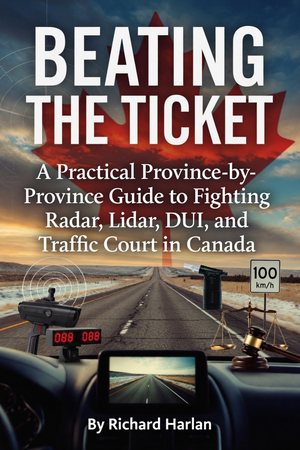
Beating the Ticket by Richard Harlan — book coverBuy on Amazon →Click cover to buy on Amazon

Beating the Ticket

A Practical Province-by-Province Guide to Fighting Radar, Lidar, DUI & Traffic Court in Canada

The premise of Beating the Ticket is that most drivers lose before they begin — not in court, but at the kitchen table, by paying the fine without ever seeing the evidence. Harlan's answer is procedural rather than rhetorical: request disclosure, read the officer's notes, check the calibration records, and find out whether the case against you is actually complete. The province-by-province structure is what makes it usable, because traffic procedure is provincial and generic advice fails precisely on that point. Notably, the book tells readers when to stop self-representing and hire a lawyer — a line most guides in this genre blur.

— Editorial assessment, The Information Station
Key Insights — Beating the Ticket

What Makes It Different

Disclosure is the whole strategy

The book's central insight is that traffic cases are won by reading the file, not by clever argument. Disclosure — the officer's notes, calibration records, operator certification — is where the weaknesses become visible.

Coverage

Genuinely province-by-province

Deadlines, forms, dispute options and the office you write to differ across Canada. What works in Ontario does not work in Alberta, and the book is structured around that reality.

Technical Clarity

Radar and lidar explained honestly

The Doppler principle, beam width, the cosine effect, and lidar sweep error are explained accurately — including where each favours the driver and where it does not.

Practical Application

Cross-examining the officer

Concrete guidance on questioning device calibration, operator training, and target identification — the three links every speed reading depends on.

Scope & Honesty

Tells you when to get a lawyer

On impaired driving the book is unambiguous: the stakes are criminal, and it says to retain counsel rather than self-represent.

Practical Application

The real cost of pleading guilty

Fines are set to make contesting feel not worth it. The book surfaces the deferred cost — demerit points and insurance premiums compounding over years — that makes the calculation look very different.

Who It's For

Written for the self-represented driver

No legal background assumed. The procedures are laid out as steps a non-lawyer can actually follow.

Coverage

Beyond speeding

Distracted driving, careless driving and impaired-driving charges each get treatment, rather than the book being a speeding-ticket manual with a broad title.

Have you read Beating the Ticket? Honest reader reviews on Amazon help other people find the book.

Leave a Review on Amazon →