
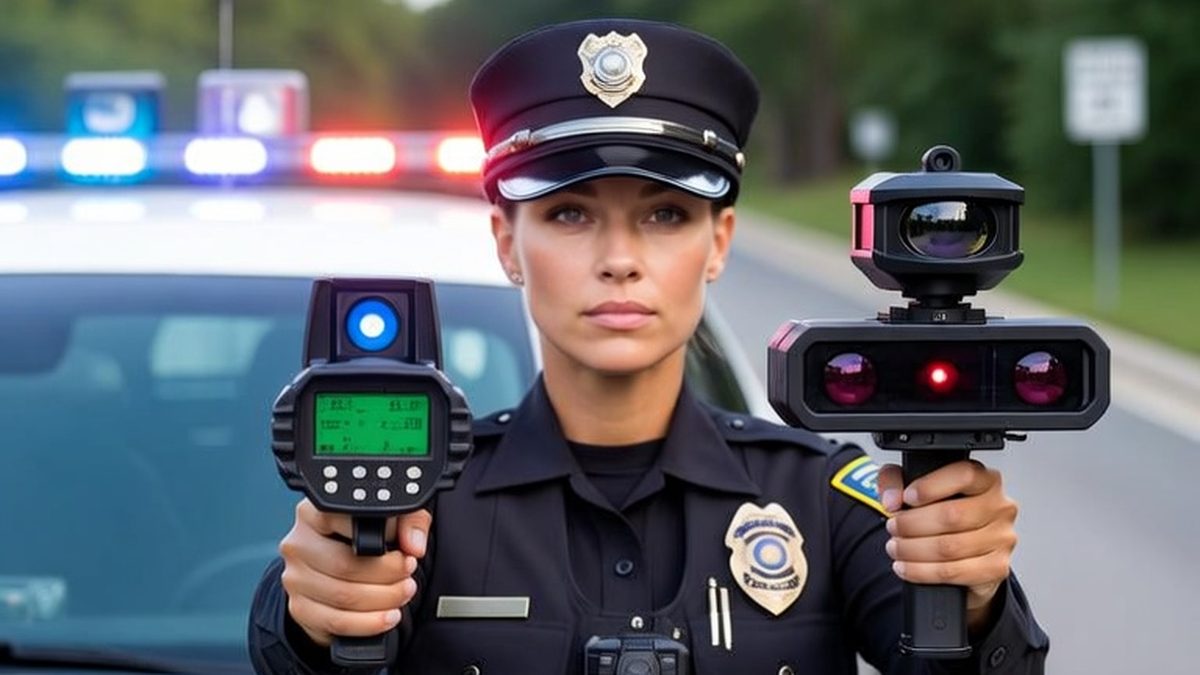
Speed-measurement devices are presented in traffic court with an aura of scientific finality. The officer states a number, the number is entered into evidence, and the number is treated as fact. But radar and lidar are instruments, and every instrument has operating conditions, failure modes, and dependencies. Understanding them is the difference between pleading guilty by default and mounting an actual defence.
This is a technical primer. It is not a promise that any particular ticket can be beaten — that depends entirely on the facts of your case and on your jurisdiction. It is an explanation of what these devices do, so that you can read your disclosure package and recognise a weakness when it is in front of you.
Radar: The Doppler Shift
Police radar transmits a continuous radio signal and listens for the reflection. When the signal bounces off a moving object, its frequency shifts in proportion to that object's velocity relative to the device — the Doppler effect. The unit converts that frequency shift into a speed reading.
This mechanism has an inherent characteristic that matters enormously in court: radar does not identify targets. It reports a speed from within a broad conical beam that widens with distance. At a few hundred metres, that cone is wide enough to encompass multiple vehicles, and the device has no capacity to tell you which one produced the reading.
- Beam width and target ambiguity. The further the target, the wider the beam, and the more vehicles that could plausibly have generated the reading. The officer's visual identification — not the device — is what links the number to your car.
- The cosine effect. Radar measures speed along the line between the device and the target. If the device is at an angle to your path of travel, the reading is mathematically lower than your true speed. This works in the driver's favour, which is precisely why officers are trained to minimise the angle — and why a badly positioned unit is an issue worth understanding.
- Batching and interference. Radar can produce spurious readings from fan blades, other patrol radar, power lines, and reflective surfaces. Documented interference effects are a recognised limitation, not a conspiracy theory.
- Moving-mode complexity. Radar operated from a moving patrol vehicle must subtract the patrol car's own speed, which it derives from a second reading off the roadway. That introduces an additional source of error absent from stationary mode.
Lidar: Timed Light Pulses
Lidar (also called laser) works on an entirely different principle. It emits rapid infrared pulses and measures the time each takes to return. Distance is calculated from that flight time; speed is calculated from how distance changes across a series of pulses.
Lidar's beam is far narrower than radar's — which largely solves the target-identification problem and is why it is favoured in dense traffic. But that narrowness creates its own dependency: the operator must hold the beam steadily on a single point of a single vehicle for the duration of the measurement.
- Sweep error. If the beam drifts across a vehicle during measurement — from the bumper to the windshield, say — the changing distance can be misread as a change in speed. Hand-held operation at distance makes this a real, documented phenomenon.
- Panning error. Movement of the operator's hand across the target introduces the same class of problem.
- Surface and angle effects. Highly reflective or sharply angled surfaces can produce anomalous returns.
The Three Dependencies Every Reading Rests On
Whichever device produced your ticket, the reading in evidence depends on three things, all of which are documentable and all of which are discoverable:
- Calibration. The device must have been tested and functioning correctly, typically before and after the shift, using the prescribed method. Calibration records exist. They can be requested.
- Operator training. The officer must be certified on the specific device. Certification records exist. They can be requested.
- Correct deployment. The device must have been used in the manner the manufacturer and the training prescribe — correct mode, correct angle, correct target acquisition, correct tracking history.
A speed reading is not a fact that fell out of the sky. It is the output of an instrument operated by a person under conditions. Each of those three links can be examined — and the mechanism for examining them is disclosure.
What This Does Not Mean
It does not mean radar and lidar are unreliable. Properly calibrated and correctly operated, both are accurate instruments, and courts are right to accord them weight. It does not mean that pointing at the cosine effect will get a ticket dismissed — in most cases it will not, because the cosine effect favours the driver.
What it means is narrower and more useful: the number on your ticket is a conclusion resting on a chain of assumptions, and you are entitled to inspect that chain. Most drivers never do. They pay the fine, absorb the demerit points, and watch their insurance premium rise for three years. The drivers who contest successfully are usually not the ones with a clever argument — they are the ones who read the disclosure and found that a link in the chain was missing.
Disclaimer: This article is for educational purposes only and does not constitute legal advice. Traffic law and procedure vary by province and territory. If you are facing a criminal charge such as impaired driving, consult a qualified lawyer.